
Do All Pending Delete Domains Drops?
Many don't reach public auction. Learn why domains get stuck, how dropcatching works, and strategies for securing these domains.
A pending delete domain is a domain name that has passed through its initial expiration date, outlived the registrar grace period, and survived the redemption period without being renewed by its original owner. This final and critical stage in a domain's lifecycle typically lasts five to seven days. After this window closes, the domain is permanently deleted from the registry database. Once it finally drops, the domain becomes available for registration again — either by the general public or by automated dropcatching services competing to secure it on behalf of eager customers.
Understanding the intricacies of the pending delete phase is essential for domainers, SEO professionals, and businesses hunting for high-quality expired domains. These digital assets can provide valuable backlinks, aged authority, and incredible branding opportunities. But the process is heavily misunderstood.
In this comprehensive guide, we will break down exactly how the pending delete phase works, whether these domains always go to auction, why some domains get "stuck" in this phase for over a week, and how you can secure them.
Understanding the Domain Expiration Lifecycle
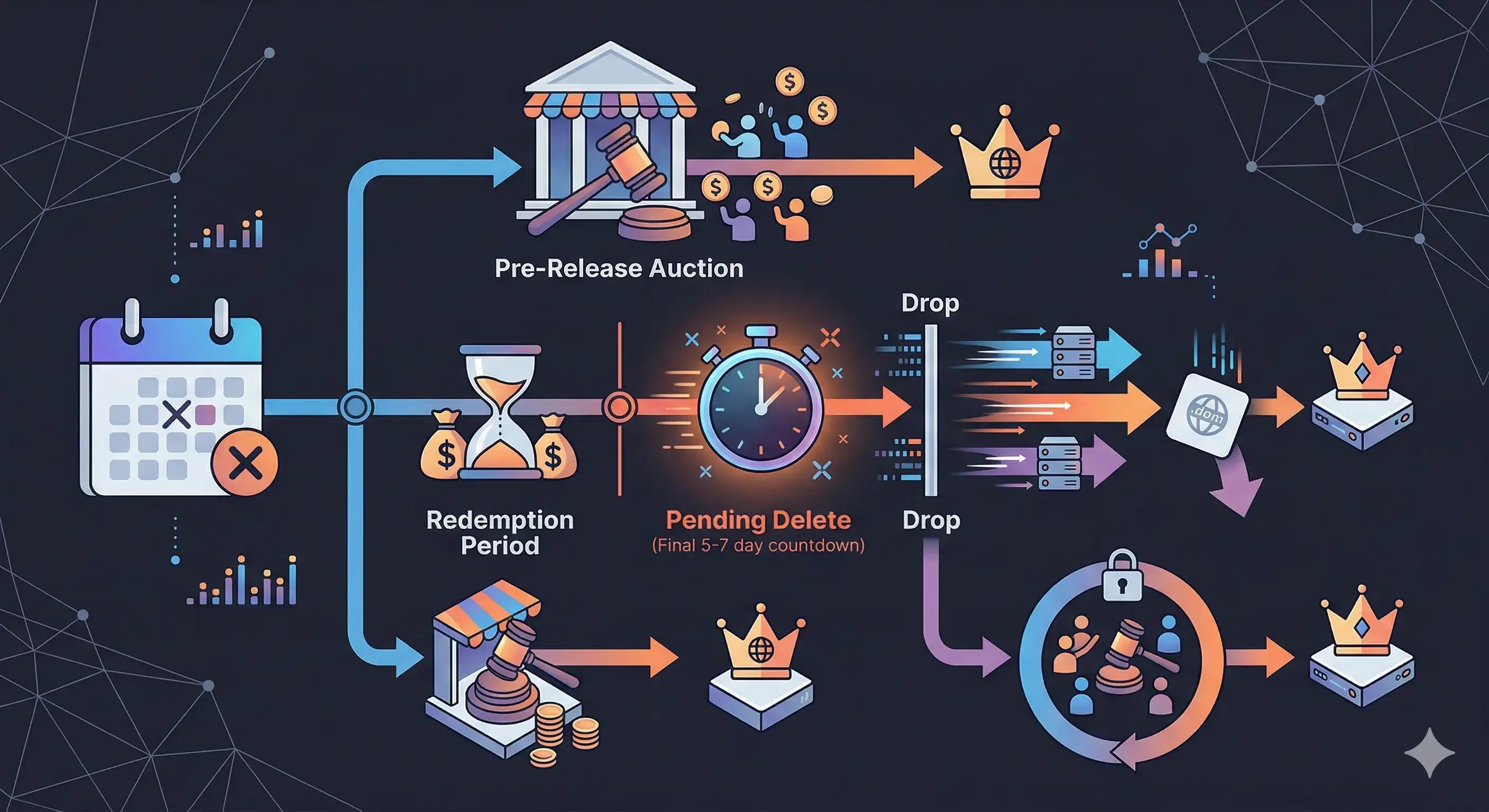
To understand the pending delete phase, you must first understand the journey a domain takes once its owner fails to pay the renewal fee. When a domain expires, it doesn't immediately disappear from the internet. Instead, it enters a multi-stage lifecycle:
- Expiration Date & Registrar Grace Period (0-45 days): The official date the domain registration ends is just the beginning. At this point, the domain might stop resolving, and associated emails may go offline. However, many registrars provide a grace period (typically up to 30 or 45 days) immediately after expiration. During this time, the original owner can usually still renew the domain at the standard price without any penalty.
- Redemption Period (30 days): If the domain is not renewed during the initial grace period, it typically enters a 30-day "redemption period". The original owner can still renew it, but they are often hit with a significantly higher "redemption fee" charged by the registrar.
- Pending Delete (5-7 days): After the redemption period concludes, the domain enters a "pending delete" status. During this 5-to-7-day window, it cannot be renewed by the original owner under any circumstances. It's effectively queued for deletion from the registry database.
- Dropped/Available: Once the pending delete period ends, the registry drops the domain, making it publicly available for anyone to register on a first-come, first-served basis.
Do Pending Delete Domains Always Go to Auction?
The short answer: no. Not all domains in the pending delete stage go through auctions or bidding marketplaces. In fact, many of the highest-value domains are sold before they ever reach the pending delete phase through exclusive registrar auction partnerships.
For example:
- GoDaddy Auctions: Expired domains registered at GoDaddy often go directly into their in-house auction platform long before hitting pending delete.
- NameJet & SnapNames: Prominent registrars like Network Solutions and Enom feed their expiring domains into these partner platforms to be auctioned off.
- Dynadot Auctions: Dynadot lists its own expired domains in a dedicated, proprietary auction marketplace.
These domains are referred to as pre-release domains, and they rarely make it to the true pending delete phase. Instead, they are auctioned off to the highest bidder while still technically under the original registrar’s control. Only domains that fail to receive bids in these pre-release auctions will continue their journey into the pending delete status.
What Happens When a Domain Reaches Pending Delete?
When a domain is not claimed during expiration or redemption, and no registrar auction successfully sells it, it enters the pending delete phase. At this stage, no one, not even the original owner or the registrar, can renew, edit, or transfer the name. It is guaranteed to drop at the end of the period.
This is exactly when dropcatching services step in. Because high-value domains are snapped up instantly, human reflexes aren't fast enough to register them. Dropcatching companies use sophisticated, automated technology with high-speed, direct connections to the registries. They send thousands of registration requests the exact millisecond a name drops from the registry. Popular services in this space include DropCatch, SnapNames, NameJet, and Pheenix.
Why Is My Domain Stuck in Pending Delete for Over 7 Days?
A common source of anxiety for domainers is watching a highly desired domain enter the pending delete phase, only for it to remain stuck there well past the standard 5-to-7-day window. If you are tracking a domain and its status isn't updating to "Available," there are several technical reasons why this happens:
1. Registry Processing Delays
The most common reason a domain appears stuck is simply that the top-level registry is still actively processing the deletion. Deleting tens of thousands of domains from a global database requires significant computing resources, and registries often process these drops in massive daily batches. If a batch is delayed, the domain remains in pending delete.
2. WHOIS/RDAP Propagation Delays
Domain information is not held in a single, centralized database. Changes don't instantly propagate across all global WHOIS/RDAP servers; it can take several hours, or even a full day, for these public records to reflect the latest "Available" information.
3. Aggressive WHOIS Server Caching
Many public WHOIS lookup services and servers employ aggressive caching to speed up query responses and reduce server load. Some WHOIS servers cache responses, meaning even if a monitoring system queries the domain, it might receive slightly stale data indicating the domain is still pending delete when it has actually already dropped.
4. Registry Glitches and Maintenance
Sometimes, domain registries themselves can experience temporary glitches, database synchronization issues, or scheduled maintenance. This can lead to inconsistent responses for a short period, pausing the drop process entirely.
Note: If you are using a professional monitoring tool like Domainyze, domains in critical phases like pendingDelete are checked at a much higher frequency (often multiple times per hour) to bypass caching where possible and give you the fastest alert.
Dropcatching and Private Auctions Explained
So, what happens if you place a backorder on a domain that is currently in pending delete? Here’s how the dropcatching process typically plays out:
- Single Backorder: If you are the only customer who places a backorder on a domain, and the dropcatching service successfully catches it the millisecond it drops, you get the domain directly for a standard flat fee.
- Multiple Backorders: If more than one person places a backorder on the exact same domain, and the service catches it, the domain goes into a private auction. Only the users who placed a backorder before the drop are allowed to bid against each other.
This dynamic is where much of the confusion arises. Many people assume the word “auction” means all pending delete domains enter a public bidding war. In reality, only domains with multiple backorders at a specific dropcatcher go to auction, and those auctions are completely closed to the general public.
Which Domains End Up in Auctions?
To clarify the entire ecosystem of expired domain acquisitions:
- Registrar Partnered Domains: Most valuable expired domains are sold through registrar auction houses (like GoDaddy Auctions or NameJet) before they ever reach pending delete.
- Unclaimed Domains: Domains without auction agreements, or those that receive zero bids in a pre-release auction, eventually reach the pending delete phase.
- Dropcaught Domains: If a pending delete domain is desirable, dropcatching services will compete to secure it at the drop. If multiple customers backordered it at the winning dropcatcher, it goes into a private aftermarket auction.
Why Pending Delete Domains Matter for SEO
For SEO professionals, link builders, and affiliate marketers, pending delete domains can be goldmines. Securing a domain with an established history can provide a massive head start for your brand identity and SEO strategy.
These domains often carry:
- Existing Backlinks: Many expired domains have a history of being online, with high-quality backlinks from other major websites and publications. This "link juice" passes immense SEO authority to your new project.
- Existing Traffic: Some expired domains still get visitors from old links, social media profiles, or bookmarks. This means you can get targeted traffic from day one.
- Bypassing the Google Sandbox: An aged, authoritative domain allows you to rank new content much faster than you ever could on a brand-new registration.
- Keyword-Rich Branding: You can often find short, memorable, and highly brandable domain names that perfectly match your new business or niche project.
However, not all domains are safe. Inheriting a toxic domain means you are inheriting its baggage. Before buying, always vet the domain using tools like Ahrefs to check Domain Rating (DR), Moz to check for a high Spam Score, and the Wayback Machine to ensure it wasn't previously used as a spammy Private Blog Network (PBN).
How to Monitor and Acquire Pending Delete Domains
The process of catching a dropped domain is highly competitive. Because the exact second a domain will be dropped by the registry is often unpredictable, doing this manually is impossible. Automated monitoring is the only reliable way to know the exact moment a desired domain becomes available.
By using a tool like Domainyze, you gain a massive competitive advantage:
- High-Frequency Checks: As a domain on your Watchlist enters the critical
pendingDeletephase, Domainyze automatically increases the frequency of its checks, often to several times per hour. - Instant Alerts: The absolute moment the system detects that the domain's status has changed to available, it triggers an immediate email or webhook alert to you.
- Avoiding the Flap: Domainyze's system is built to handle inconsistent WHOIS data propagation and registry glitches by performing multiple retries to confirm a status change before alerting you.
Key Takeaways
Not all domains in pending delete go to auction. Many are sold earlier via registrar partnerships, while true pending delete names are caught by specialized services the millisecond they drop. Furthermore, if a domain appears stuck in pending delete for over 7 days, it is almost always due to registry processing delays or WHOIS caching.
Whether you’re an SEO strategist looking to build an authoritative niche site, a domain investor flipping digital real estate, or an entrepreneur looking for the perfect brand name, understanding the expiration lifecycle can save you thousands of dollars. Vet your domains carefully.
Start Monitoring With Domainyze
Start monitoring and catching domains today.
Join founders, agencies, and domain investors using Domainyze to track changes, risks, and acquisition opportunities before they slip away.
Create Free AccountNo card required